Solving A2A Async Reliable Communication with mq9
What Is A2A
AI agents are multiplying. A typical system now has several collaborating agents: one for search, one for analysis, one for report generation. These agents may be built with different frameworks (LangChain, CrewAI, AutoGen) and running on different servers. Agent A wants to call Agent B, but doesn't know where B is, what it can do, or what its interface looks like.
A2A (Agent2Agent) is a standardization protocol launched by Google with the goal of letting agents built by different frameworks and different companies discover and call each other. It's now a Linux Foundation project with 100+ companies behind it.
Three core concepts:
AgentCard: Each agent exposes a JSON file at a fixed URL (/.well-known/agent.json) describing who it is, what it can do, and how to reach it.
{
  "name": "DataAnalysisAgent",
  "description": "Analyzes data and generates reports",
  "url": "https://agent-b.example.com",
  "version": "1.0.0",
  "skills": [
    {
      "id": "data_analysis",
      "name": "Data Analysis",
      "description": "Analyzes input data and returns an insights report"
    }
  ]
}Task: A standardized task object defining the format for "send a task, track progress, retrieve the result."
HTTP communication: Agent A reads Agent B's AgentCard, then sends a Task to B using standard HTTP + JSON-RPC.
A2A's Async Blind Spot
A2A solves agent interoperability, but there's one scenario it handles poorly: the receiver is offline.
A2A supports three interaction modes:
- Synchronous request/response: Send and wait for the result — fails immediately if Agent B is offline
- SSE streaming: Good for streaming progress on long tasks, but messages are lost when the connection drops
- Push notification: Requires Agent B to expose a reachable callback URL — fails the same way if B is offline
All three share one assumption: the receiver must be online and reachable.
In production, this is a real problem. Agent restarts, network blips, and task backlogs are the norm. A2A has no built-in message persistence; reliability is entirely up to the application layer.
Beyond that:
- No priority: Urgent and routine tasks are treated the same
- No broadcast: Sending one task to multiple agents requires a separate HTTP call per agent
- Network isolation: Agents behind a corporate firewall can't expose a public HTTP address, making cross-network collaboration difficult
What mq9 Is
mq9 is a messaging protocol designed specifically for async agent communication. Its core abstraction is the Mailbox.
Each agent has a Mailbox. Other agents drop messages into it; messages are persisted in the broker; the receiver picks them up whenever it's ready. Sender and receiver don't need to be online at the same time.
Key features:
- Persistence: Messages are stored in the broker and won't be lost before their TTL expires
- Offline-safe: Messages sent while the receiver is offline are retained and delivered when it comes back online
- Priority: Three levels — critical / urgent / normal — urgent messages are processed first
- Fan-out: Multiple agents can subscribe to the same Mailbox; one send reaches all of them
- Network flexibility: Both sides just need to reach the same broker — no direct network path required between agents
mq9 is built on the NATS protocol and provides SDKs for Python, Go, Java, Rust, JavaScript, and C#.
Filling A2A's Gap with mq9
The core idea is simple: replace A2A's HTTP transport layer with mq9.
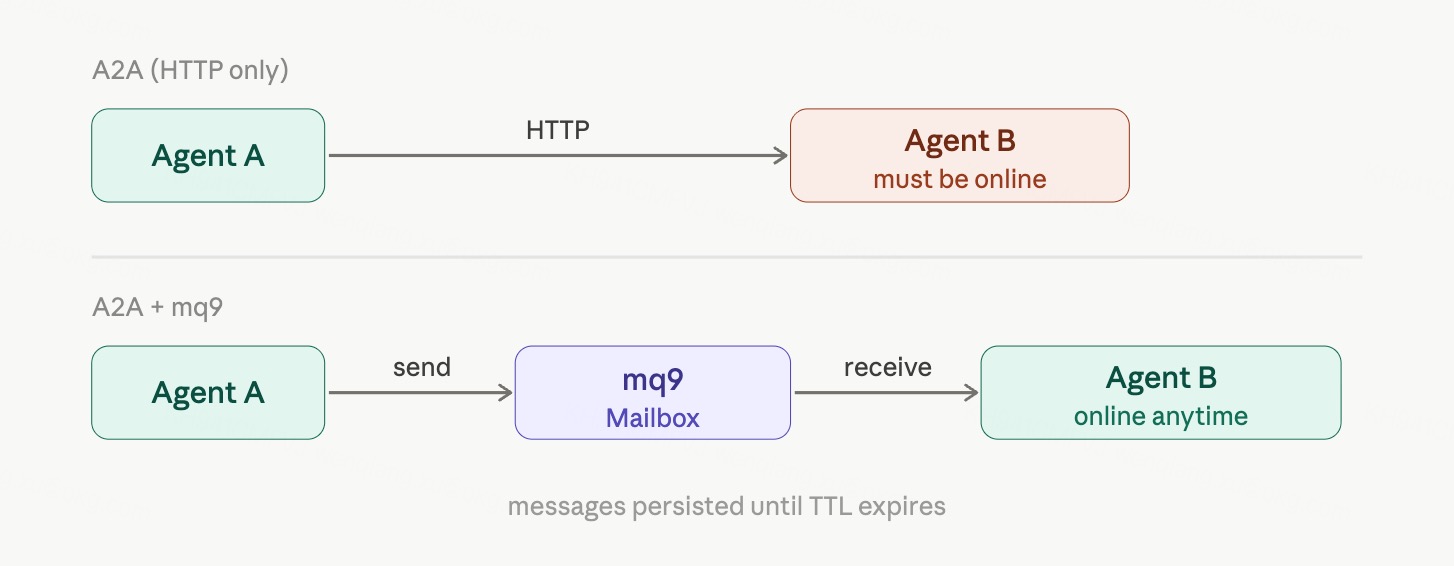
A2A handles task format (Task) and capability discovery (AgentCard). mq9 handles reliable async delivery.
This works today. No standardization work needed. The only thing required is serializing an A2A Task to JSON before sending to mq9, and deserializing it on the receiving end.
Hands-on: Complete Example
Install
pip install langchain-mq9 langchain-openaiCommunication Flow
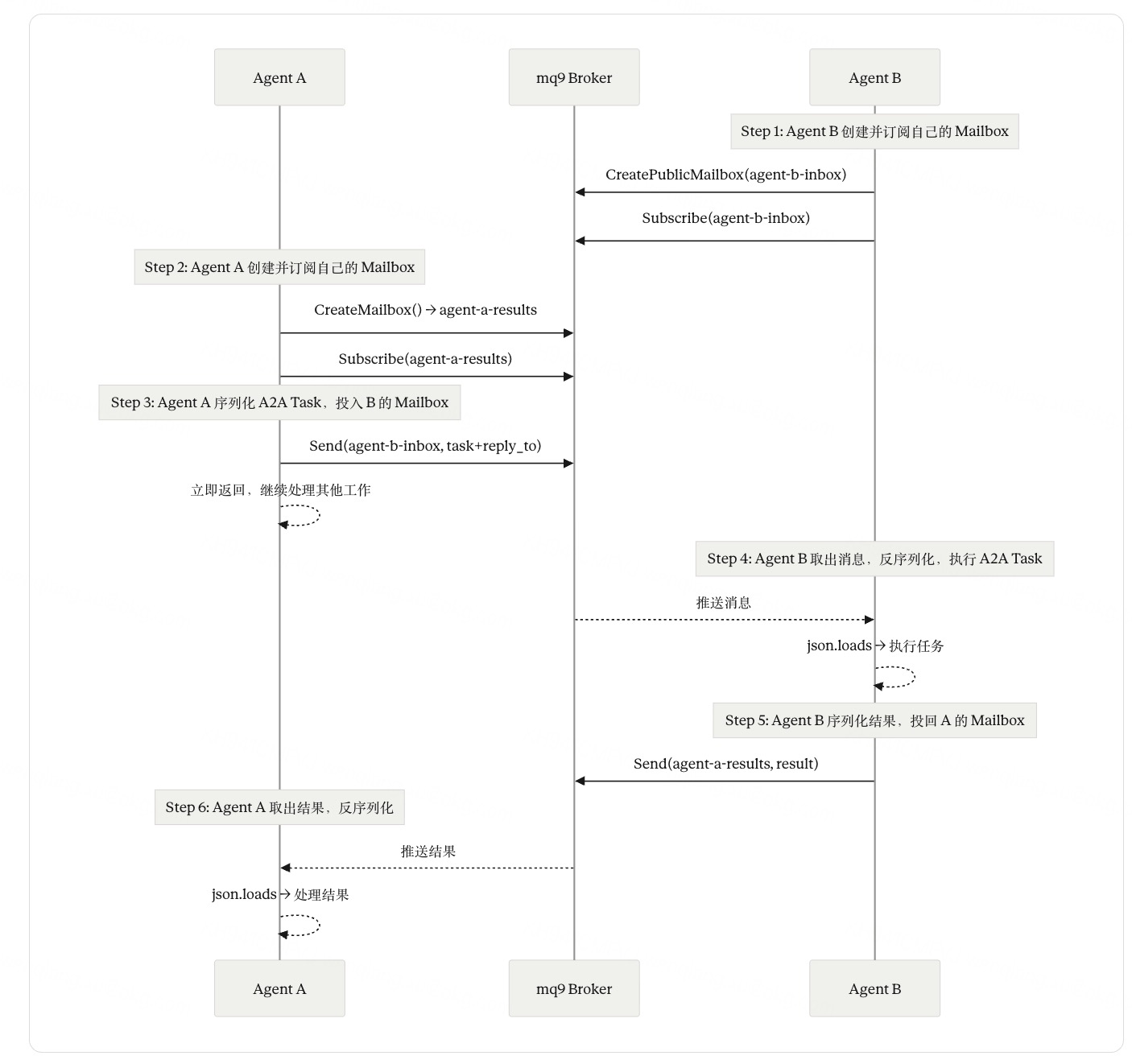
agent_b.py
Agent B runs independently. On startup it creates its Mailbox and subscribes, then waits continuously for tasks.
# agent_b.py
import asyncio
import json
from langchain_mq9 import Mq9Toolkit, CreatePublicMailboxTool
from langchain.agents import AgentType, initialize_agent
from langchain_openai import ChatOpenAI
from robustmq.mq9 import Client

SERVER = "nats://demo.robustmq.com:4222"

async def main():
    toolkit = Mq9Toolkit(server=SERVER)
    tools = toolkit.get_tools()
    llm = ChatOpenAI(model="gpt-4o-mini")

    # Step 1: Agent B creates its Mailbox
    await CreatePublicMailboxTool(server=SERVER)._arun(
        name="agent-b-inbox",
        ttl=86400,
        desc="Agent B task queue"
    )
    print("Agent B: Mailbox ready, subscribing to agent-b-inbox...")

    agent_b = initialize_agent(
        tools, llm,
        agent=AgentType.OPENAI_FUNCTIONS,
        verbose=True,
    )

    # Step 2: Subscribe to the Mailbox; callback fires when a message arrives
    # Step 4: Deserialize and execute the A2A Task
    # Step 5: Serialize the result and send it back to the reply_to Mailbox
    async def on_message(msg):
        task = json.loads(msg.data)
        print(f"Agent B: received task {task['task_id']}")

        agent_b.invoke({
            "input": f"Execute a {task['type']} task on data: {task['payload']}. "
                     f"Serialize the result with json.dumps and send it to the Mailbox "
                     f"with mail_id {task['reply_to']} at normal priority."
        })

    async with Client(SERVER) as client:
        await client.subscribe("agent-b-inbox", on_message)
        print("Agent B: subscribed, waiting for tasks...")
        await asyncio.sleep(float("inf"))  # run indefinitely

asyncio.run(main())
agent_a.py
Agent A runs independently. It creates its own result Mailbox, sends the task and immediately moves on, then retrieves the result asynchronously.
# agent_a.py
import asyncio
import json
from langchain_mq9 import Mq9Toolkit, CreateMailboxTool
from langchain.agents import AgentType, initialize_agent
from langchain_openai import ChatOpenAI

SERVER = "nats://demo.robustmq.com:4222"

async def main():
    toolkit = Mq9Toolkit(server=SERVER)
    tools = toolkit.get_tools()
    llm = ChatOpenAI(model="gpt-4o-mini")

    agent_a = initialize_agent(
        tools, llm,
        agent=AgentType.OPENAI_FUNCTIONS,
        verbose=True,
    )

    # Step 2: Agent A creates its result Mailbox
    result_mailbox = await CreateMailboxTool(server=SERVER)._arun(ttl=3600)
    print(f"Agent A: result Mailbox ready → {result_mailbox}")

    # Step 3: Serialize an A2A Task and send it to Agent B's Mailbox
    a2a_task = {
        "task_id": "task-001",
        "type": "data_analysis",
        "payload": "dataset_v1: [record_1, record_2, record_3]",
        "reply_to": result_mailbox  # tells Agent B where to send the result
    }
    agent_a.invoke({
        "input": "Send a normal-priority message to the Mailbox with mail_id agent-b-inbox: " + json.dumps(a2a_task)
    })
    print("Agent A: task sent, continuing with other work...")
    print("(Whether Agent B is online right now doesn't matter — the message is persisted)")

    # Do other work in the meantime...
    await asyncio.sleep(10)

    # Step 6: Retrieve the result asynchronously and deserialize it
    agent_a.invoke({
        "input": f"Read messages from the Mailbox with mail_id {result_mailbox}, parse with json.loads, and output the analysis result"
    })

asyncio.run(main())
Running It
Start Agent B first, then Agent A:
# Terminal 1: start Agent B — creates Mailbox, subscribes, waits
python agent_b.py

# Terminal 2: start Agent A — sends task, retrieves result asynchronously
python agent_a.py
If Agent B is offline when Agent A sends, the task is persisted in the Mailbox and automatically picked up when Agent B comes back online.
Priority: Urgent Tasks Jump the Queue
A2A has no built-in priority mechanism. With mq9, critical messages are always processed before normal and low — no need to maintain multiple queues.
# Routine task
agent_a.invoke({
    "input": f"Send a normal-priority message to 'agent-b-inbox': {json.dumps({'task_id': 'task-002', 'type': 'batch_report'})}"
})

# Urgent task — Agent B will always process this first, regardless of send order
agent_a.invoke({
    "input": f"Send a critical-priority message to 'agent-b-inbox': {json.dumps({'task_id': 'task-003', 'type': 'incident_analysis', 'payload': 'Payment system anomaly detected'})}"
})
Broadcast: One Task to Multiple Agents
# Create a broadcast channel
await CreatePublicMailboxTool(server=SERVER)._arun(
    name="all-agents-broadcast",
    ttl=86400
)

# Send once — every agent subscribed to this Mailbox receives it
agent_a.invoke({
    "input": f"Send a normal-priority message to 'all-agents-broadcast': {json.dumps({'type': 'config_update', 'payload': 'System config updated, please reload'})}"
})
Cross-Network Collaboration
A2A's HTTP model requires both sides to be network-reachable, which means agents behind a corporate firewall can't directly expose a public HTTP address.
mq9 works differently: both sides just need to reach the same broker.
# Public internet
SERVER = "nats://demo.robustmq.com:4222"
Any agent with internet access can communicate through this broker

# Corporate intranet
SERVER = "nats://192.168.1.100:4222"
Deploy RobustMQ on-prem; all internal agents connect through the internal broker
Data never leaves the network — meets security and compliance requirements

# Hybrid
internal broker ──federation──▶ public broker
Internal and external agents communicate through federation; outbound data flow is controlled
The broker address can be public or self-hosted. Switching is one config change.
A2A Native HTTP vs. A2A + mq9
| A2A Native HTTP | A2A + mq9 | |
|---|---|---|
| Receiver offline | Task is lost | Message persisted, delivered when receiver comes online |
| Sender blocked | Waits for response | Fire and forget, non-blocking |
| Priority | No built-in support | critical / urgent / normal, automatically ordered |
| Broadcast | One HTTP call per agent | Multiple agents subscribe to one Mailbox |
| Network isolation | Both sides must be reachable | Only need to reach the same broker |
| Network blip | Request fails, needs retry | Message already persisted, unaffected |
Current Limitations
Manual serialization/deserialization of A2A Tasks: json.dumps() the Task before sending to mq9, json.loads() on the receiving end. There's no ready-made library wrapping this yet — you write it yourself.
Out-of-band mail_id sharing: Agent B's Mailbox address needs to be agreed on in advance. How agents automatically discover each other is a separate problem — mq9 solves it via $SYSTEM.PUBLIC, covered in Adding Agent Discovery and Async Communication to A2A with mq9.
Summary
A2A solves agent interoperability but has a clear gap in async reliable communication: the receiver must be online, messages aren't persisted, and there's no priority. mq9 fills it.
The two work together today — no standardization needed. A2A handles capability discovery and task format; mq9 handles reliable delivery.
Resources
- A2A protocol: github.com/a2aproject/A2A
- mq9 protocol spec: docs/mq9-protocol.md
- langchain-mq9: github.com/robustmq/robustmq-sdk/tree/main/langchain-mq9
- RobustMQ: github.com/robustmq/robustmq
- Demo server:
nats://demo.robustmq.com:4222(connect directly for testing, no local deployment needed)