The Kafka Protocol, Implemented in Rust, Is Here

This is an announcement post: RobustMQ now has a Kafka-compatible protocol layer running on top of its unified kernel. This is not a Kafka rewrite — it's a protocol adapter over the same storage and metadata layer that already serves MQTT.
What's supported
66 Kafka APIs are implemented and working end to end.
Current limitations
To be upfront about where this stands today:
- No transactions
- No KIP-932 share groups
- Fetch does not support compression yet
- Permissions and quotas aren't enforced at runtime yet
- No replica-migration or manual-leader-switch admin APIs — these aren't needed in the same way Kafka needs them, since storage and Raft already handle data placement and failover underneath
Testing done so far
Around 200 integration tests running against a 3-node cluster, tests against real Java Kafka clients, and verification against the official Kafka CLI tools.
Architecture
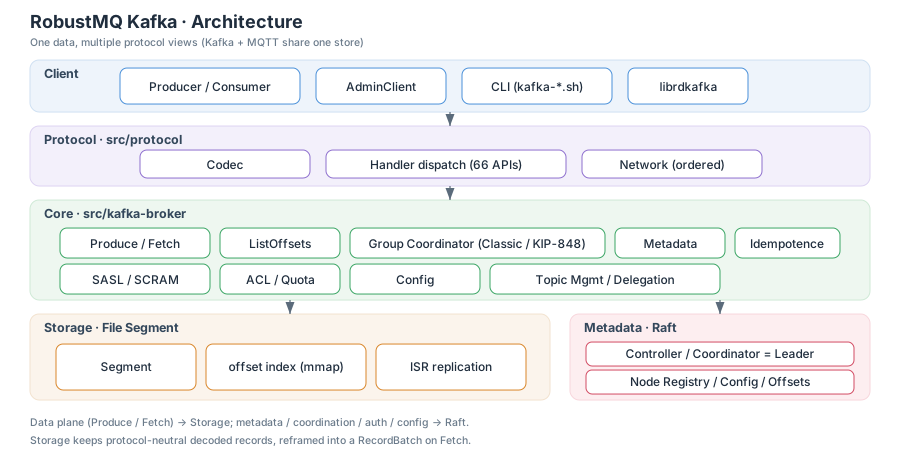
Five layers: client → protocol codec → core semantics → File Segment storage → Raft metadata.
Core technical features
- Raft-based metadata, no ZooKeeper, no KRaft needed. RobustMQ already has its own metadata/Raft layer; Kafka's protocol support rides on it directly instead of bringing in a separate metadata system.
- File Segment storage. Same segment-based append-only log used across the rest of the system.
- Both old and new rebalance protocols. The classic protocol and KIP-848 are both implemented and usable.
- Segment-level data rebalancing instead of partition reassignment. New capacity gets new segments placed on it, rather than requiring existing partition data to be copied around.
- ISR replication with epoch fencing. Standard correctness guarantees around replica catch-up and leader epochs.
- Rust plus an append-only design for performance.
What's next

AMQP is next up — it's another data point for validating the "one kernel, many protocols" architecture, this time against a protocol with a very different consumption model than Kafka or MQTT.
Beyond that, there's mq9 — not a compatibility layer for an existing standard, but a brand-new protocol built specifically for AI agent communication.