
Pluggable Storage Architecture
RobustMQ decouples the Broker from its storage backend through the StorageAdapter trait. The Broker calls only the trait interface and has no awareness of whether the underlying implementation is Memory, RocksDB, File Segment, or an external storage system.
StorageAdapter Trait
#[async_trait]
pub trait StorageAdapter {
    async fn create_shard(&self, shard: ShardConfig) -> Result<(), StorageError>;
    async fn delete_shard(&self, shard_name: String) -> Result<(), StorageError>;
    async fn list_shard(&self, filter: ShardFilter) -> Result<Vec<ShardInfo>, StorageError>;

    async fn write(&self, shard_name: String, record: Record) -> Result<u64, StorageError>;
    async fn batch_write(&self, shard_name: String, records: Vec<Record>) -> Result<Vec<u64>, StorageError>;

    async fn read_by_offset(&self, shard_name: String, offset: u64, limit: u64) -> Result<Vec<Record>, StorageError>;
    async fn read_by_tag(&self, shard_name: String, tag: String, offset: u64, limit: u64) -> Result<Vec<Record>, StorageError>;
    async fn read_by_key(&self, shard_name: String, key: String) -> Result<Option<Record>, StorageError>;

    async fn delete_by_offset(&self, shard_name: String, offset: u64) -> Result<(), StorageError>;
    async fn delete_by_key(&self, shard_name: String, key: String) -> Result<(), StorageError>;

    async fn get_offset_by_timestamp(&self, shard_name: String, timestamp: u64) -> Result<Option<u64>, StorageError>;
    async fn get_offset_by_group(&self, group_name: String, shard_name: String) -> Result<Option<u64>, StorageError>;
    async fn commit_offset(&self, group_name: String, shard_name: String, offset: u64) -> Result<(), StorageError>;
}
Three Built-in Implementations
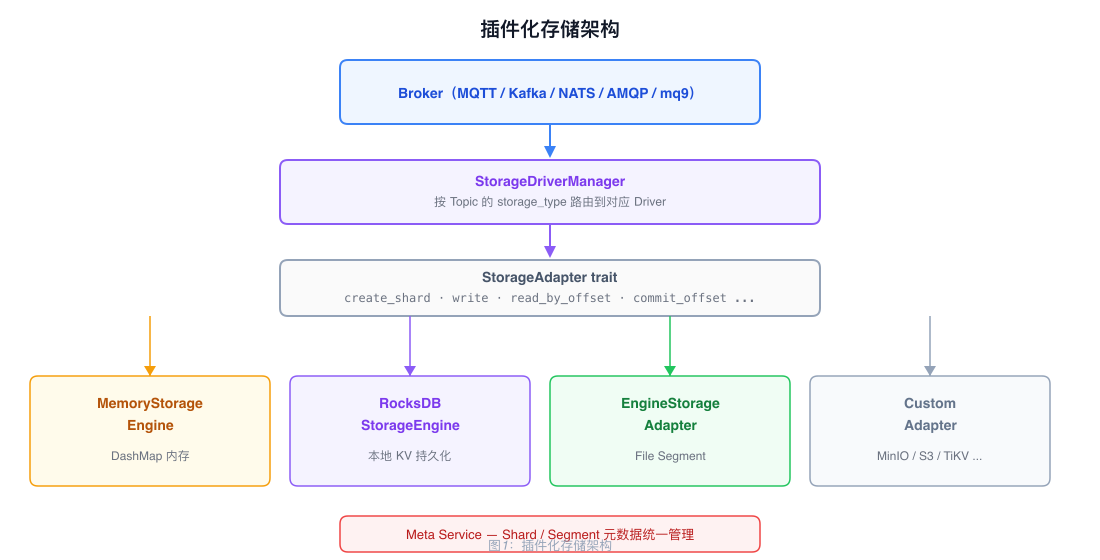
| Implementation | Struct | Description |
|---|---|---|
| Memory storage | MemoryStorageEngine | DashMap; data is lost on process restart |
| RocksDB storage | RocksDBStorageEngine | Local KV store; single-node persistence |
| File Segment storage | EngineStorageAdapter → StorageEngineHandler | Segmented log; multi-replica cluster storage |
Routing Mechanism
StorageDriverManager selects the implementation based on the storage_type configured on the Topic:
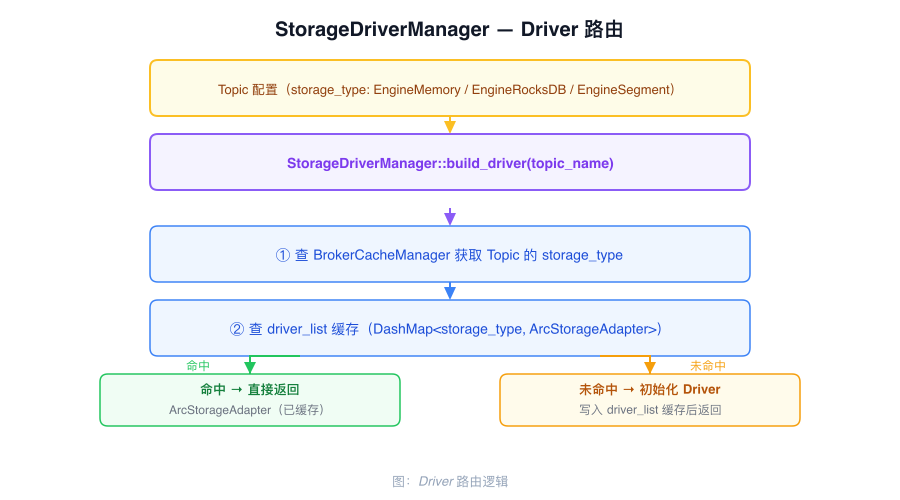
Routing logic: when the Broker writes a message, it first reads the target Topic's storage_type field from BrokerCacheManager, then looks up an already-initialized Driver instance in driver_list (DashMap<String, ArcStorageAdapter>). On a cache miss, init_driver creates an instance by type, stores it in the map, and returns it. Driver instances are typed as Arc<dyn StorageAdapter> and are shared across requests without re-initialization.
Different Topics within the same cluster can use different storage backends (mixed storage). Switching the storage type for a Topic requires only a configuration change; no Broker code modification is needed.
Integrating External Storage
Any external storage system (e.g., MinIO, S3, TiKV, MySQL) can be integrated by implementing the StorageAdapter trait:
- Create a new struct that implements all methods of
StorageAdapter - Add the corresponding
storage_typebranch inStorageDriverManager::init_driver - Specify the new
storage_typein the Topic configuration
Shard and Segment Metadata
Shard and Segment metadata for all storage backends is managed centrally by Meta Service:
- Shard creation, deletion, and partition configuration are stored in Meta Service's metadata Raft Group
- File Segment
active_segment, Leader information, and ISR lists are stored in Meta Service - Brokers cache hot data in a local
StorageCacheManagerto reduce round-trips to Meta Service