Skip to content

Storage Adapter Architecture

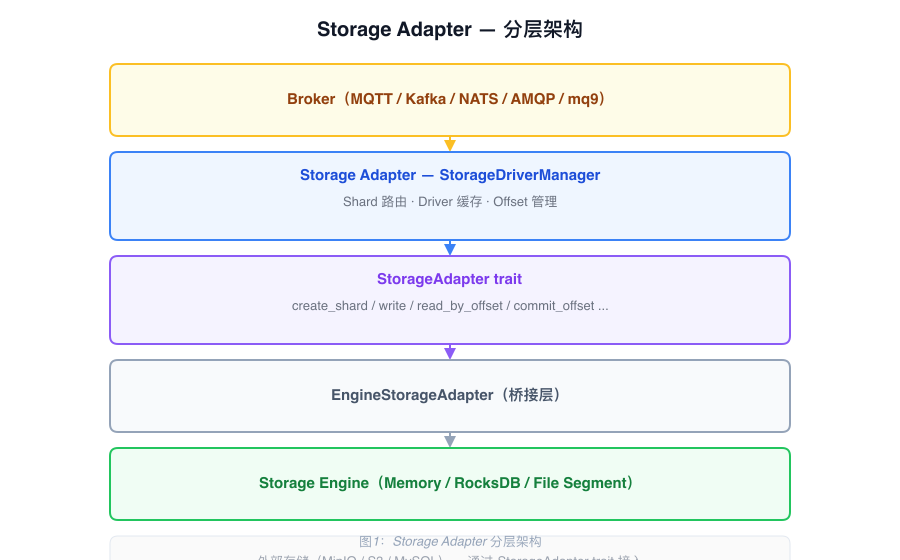
Storage Adapter is RobustMQ's storage abstraction layer, sitting between the Broker (MQTT, Kafka, and other protocol handlers) and the Storage Engine (underlying storage backends). Its core responsibility is: unifying different protocol storage concepts into the Shard abstraction, and transparently routing read/write operations to the appropriate storage backend — fully decoupling the upper-layer protocols from the lower-layer storage.


Overall Structure

MQTT Broker / Kafka Broker / ...
           │ Topic name

  StorageDriverManager          ← Entry point, routes by Topic to the appropriate Driver
           │ lookup Topic config
           ├── BrokerCacheManager (Topic metadata cache)


  EngineStorageAdapter           ← Implements the StorageAdapter trait


  StorageEngineHandler           ← Unified storage engine handler
     ┌─────┼──────────┐
     │     │          │
  Memory  RocksDB  FileSegment   ← Three storage backends

Core Concept: Shard

Shard is the core abstraction unit of Storage Adapter, unifying storage concepts across different protocols:

ProtocolOriginal ConceptMaps To
MQTTTopicShard
KafkaPartitionShard
AMQP (planned)QueueShard

One Topic corresponds to a group of Shards (multi-partition). Shard naming convention:

{topic_id}_{partition_seq}

Each Shard has its own storage type configuration (EngineMemory / EngineRocksDB / EngineSegment). Shard and Segment metadata are managed centrally by Meta Service.


Key Components

StorageAdapter Trait

The unified interface that all storage backends must implement, defining all storage operations available to Brokers:

MethodDescription
create_shardCreate a Shard (corresponds to creating a Topic / Partition)
delete_shardDelete a Shard
list_shardList Shards
writeWrite a single message, return Offset
batch_writeBatch write messages
read_by_offsetRead messages by Offset
read_by_tagRead messages by Tag
read_by_keyRead messages by Key
delete_by_keyDelete message by Key
delete_by_offsetDelete message by Offset
get_offset_by_timestampFind Offset corresponding to a timestamp
get_offset_by_groupQuery consumer group Offset
commit_offsetCommit consumer group Offset

StorageDriverManager

The externally-facing entry point for Storage Adapter. Brokers call this component directly.

FieldTypeDescription
driver_listDashMap<String, ArcStorageAdapter>Driver cache keyed by storage type — avoids repeated initialization
engine_storage_handlerArc<StorageEngineHandler>Underlying engine handler
broker_cacheArc<BrokerCacheManager>Topic metadata cache, queried during routing
offset_managerArc<OffsetManager>Consumer group Offset management
message_seqAtomicU64Global write sequence counter for round-robin partition selection

Topic routing logic (build_driver):

  1. Query Topic config (including storage_type) from BrokerCacheManager
  2. Look up the driver_list cache by storage_type — return directly on cache hit
  3. On cache miss: initialize the Driver and insert into cache

EngineStorageAdapter

Implements the StorageAdapter trait by delegating calls to StorageEngineHandler. It is the bridge between Storage Adapter and Storage Engine.


Write Flow

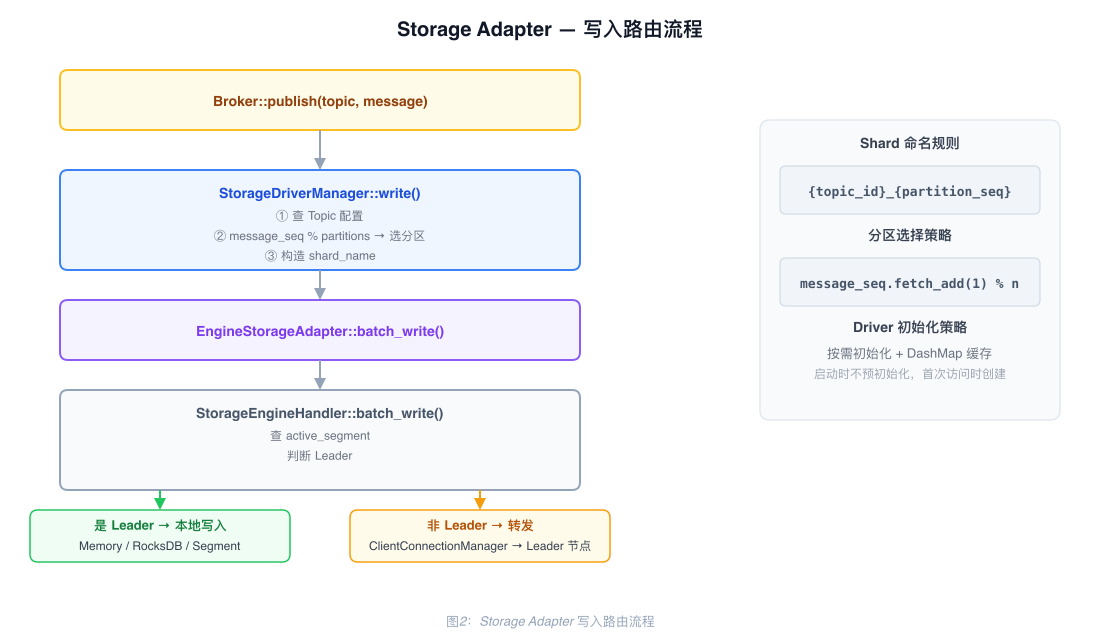
Broker::publish(topic, message)


StorageDriverManager::write(topic_name, records)

        ├── 1. Lookup Topic config (BrokerCacheManager)
        ├── 2. Select target partition: message_seq % topic.partition (round-robin)
        ├── 3. Build shard_name = build_storage_name(topic_id, partition)


EngineStorageAdapter::batch_write(shard_name, records)


StorageEngineHandler::batch_write(shard_name, records)

        ├── Query StorageCacheManager for Shard config and active_segment
        ├── Check if current node is the Leader of active_segment

        ├── Is Leader: write locally
        │       ├── EngineMemory → MemoryStorageEngine (DashMap in-memory)
        │       ├── EngineRocksDB → RocksDBStorageEngine (RocksDB Column Family)
        │       └── EngineSegment → WriteManager (segmented file log)

        └── Not Leader: forward to Leader node
                └── ClientConnectionManager::write_send(leader_broker_id, ...)

Partition Selection Strategy

Round-robin using a global atomic counter:

partition = message_seq.fetch_add(1) % topic.partition

Topic Creation Flow

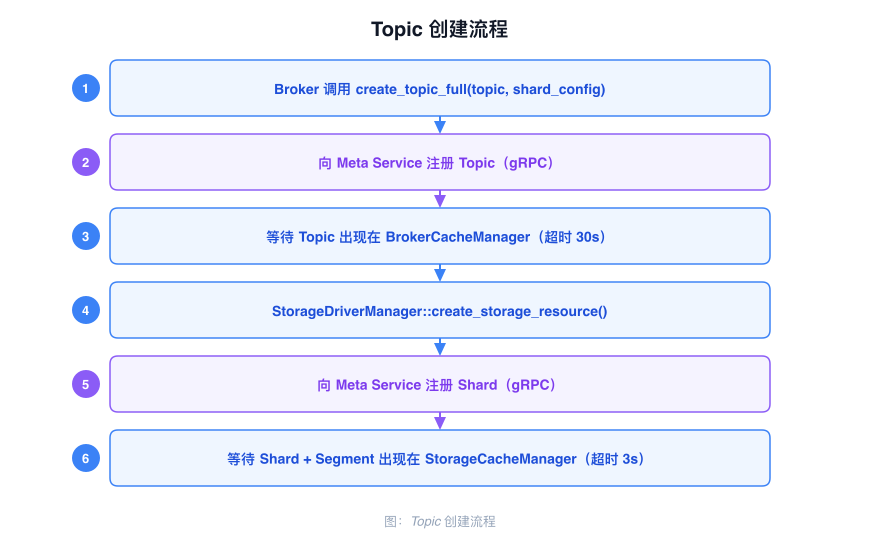
Topic creation is a coordinated process across Meta Service and Storage Engine:

1. Broker calls create_topic_full(topic, shard_config)


2. Register Topic to Meta Service (gRPC: placement_create_topic)


3. Wait for Topic to appear in BrokerCacheManager (timeout: 30s)
   Meta Service → push config → Broker local cache updated


4. StorageDriverManager::create_storage_resource(topic_name)


5. Register Shard to Meta Service (gRPC: create_shard)


6. Wait for Shard + Segment to appear in StorageCacheManager (timeout: 3s)

Three Storage Backends

EngineMemory (In-Memory)

Pure in-memory storage based on DashMap with multi-dimensional indexes:

IndexStructurePurpose
Primary dataDashMap<shard, DashMap<offset, Record>>Read by Offset
Tag indexDashMap<shard, DashMap<tag, Vec<offset>>>Query by Tag
Key indexDashMap<shard, DashMap<key, offset>>Query by Key (unique)
Timestamp indexDashMap<shard, DashMap<timestamp, offset>>Find Offset by time

Characteristics: Microsecond latency. Data lost on process restart. Suitable for real-time metrics, ephemeral notifications.

EngineRocksDB (RocksDB Persistent)

Persistent storage backed by RocksDB, using a dedicated Column Family (DB_COLUMN_FAMILY_BROKER). Per-Shard write locks prevent concurrent write conflicts.

Characteristics: Millisecond latency, durable storage, supports read by Offset / Tag / Key. Suitable for IoT device messages, offline messages.

EngineSegment (Segmented File Log)

A segmented log file storage engine managed by WriteManager:

  • Each Shard consists of multiple Segment files (rolling log)
  • Each Segment has a designated Leader Broker node responsible for writes
  • Segment metadata (start/end Offset, status, etc.) is managed by Meta Service
  • Writes are processed in batches via async channels (WriteManager) for high throughput
  • Supports Tag and Key index construction (save_index)

Characteristics: High-throughput durable storage with Segment rolling. Suitable for big data streams, Kafka scenarios.


Offset Management

OffsetManager handles consumer group Offset management with two storage strategies:

StrategyImplementationDescription
Cache storage (enable_cache=true)OffsetCacheManagerLocal RocksDB cache, low latency
Persistent storageOffsetStorageManagerWrites to Meta Service, strong consistency

Offset queries support timestamp-based lookup strategies (AdapterOffsetStrategy) to find the Offset at a specific point in time.


Design Highlights

FeatureDescription
Protocol-transparentBrokers only pass Topic name; storage type is determined by Topic config, fully transparent to Broker
Topic-level storage configDifferent Topics can use different backends; mixed storage in a single cluster is supported
Leader-aware forwardingWrite operations automatically identify the Segment Leader; non-Leader nodes transparently forward, Broker needs no topology awareness
Lazy Driver initializationDrivers are initialized on demand and cached, avoiding resource contention at startup
Unified Offset semanticsAll three backends follow the same Offset model, ensuring consistent consumer logic