
Connector Architecture
Connectors stream messages from a Broker to external data systems in real time. They run on Broker nodes and are scheduled centrally by the Meta Service.
Overall Structure
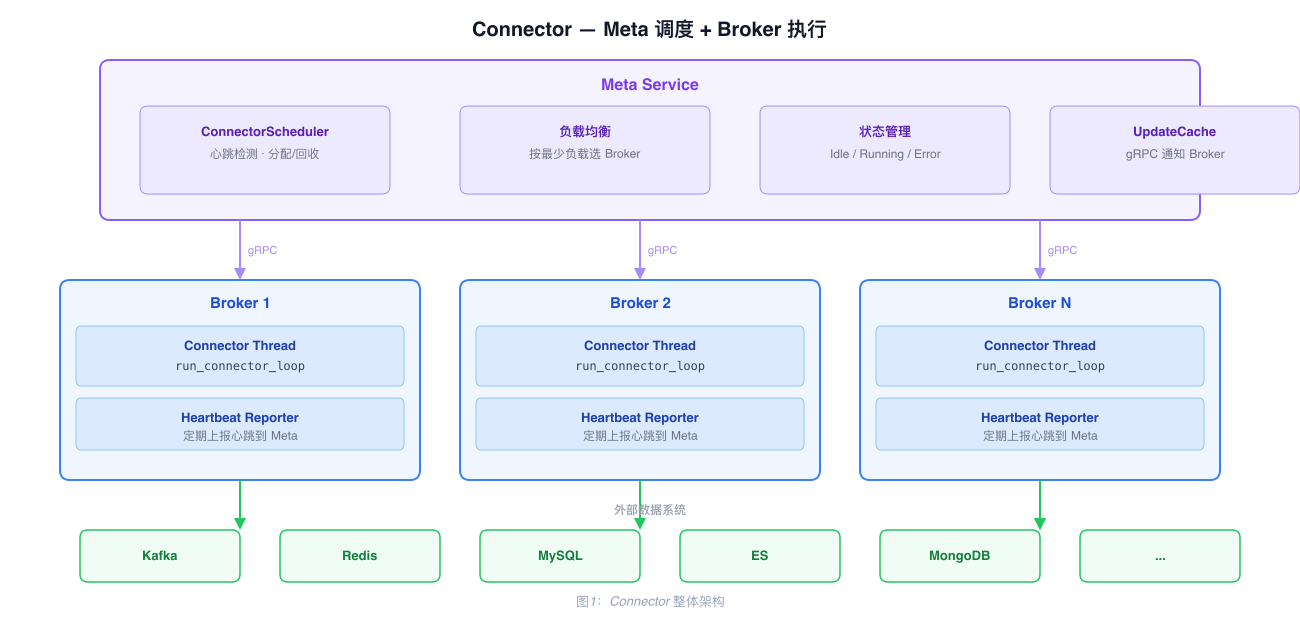
The architecture uses Meta for scheduling and Broker for execution:
ConnectorSchedulerin Meta Service handles Connector assignment, reclamation, and state management- Broker nodes execute the actual consume-and-write logic
- State is synchronized between the two via gRPC (UpdateCache)
Lifecycle
A Connector has four states, maintained centrally by Meta Service:
| State | Meaning |
|---|---|
Idle | Unassigned; waiting for the scheduler to assign it to a Broker |
Running | Assigned to a Broker; the Broker-side thread is active |
Stopped | Manually stopped by the user; excluded from scheduling |
Error | Failed during execution; awaiting retry or manual intervention |
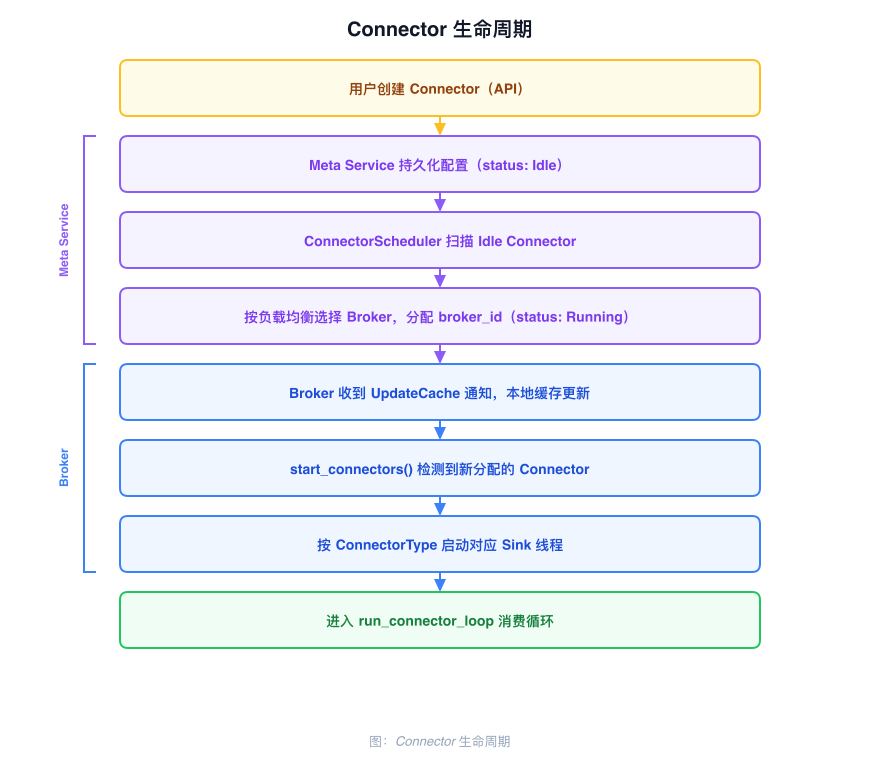
State transitions: created as Idle → assigned by the scheduler becomes Running → heartbeat timeout or Broker down resets to Idle → re-enters scheduling.
Meta Scheduling (ConnectorScheduler)
Two tasks run every second:
Heartbeat check (check_heartbeat): Iterates over all Connectors and checks their last heartbeat time. If a Connector has timed out, it is marked Idle, its broker_id assignment is cleared, and it waits for rescheduling.
Assignment and reclamation (start_stop_connector_thread):
- Collects all Connectors in Idle state
- Calculates load per Broker (number of assigned Connectors)
- Assigns using least-load selection
- Updates status to Running and notifies the Broker via UpdateCache
Broker-Side Scheduling
The Broker's start_connector_thread runs two checks every second:
Start check (start_connectors): Iterates over all Connectors in the local cache. If a Connector is assigned to the current Broker and its thread is not running, starts the corresponding Sink thread by ConnectorType.
Reclaim check (gc_connectors): Iterates over all running threads. If the corresponding Connector is no longer assigned to the current Broker, sends a stop signal and updates its status to Idle.
Consume Loop (run_connector_loop)
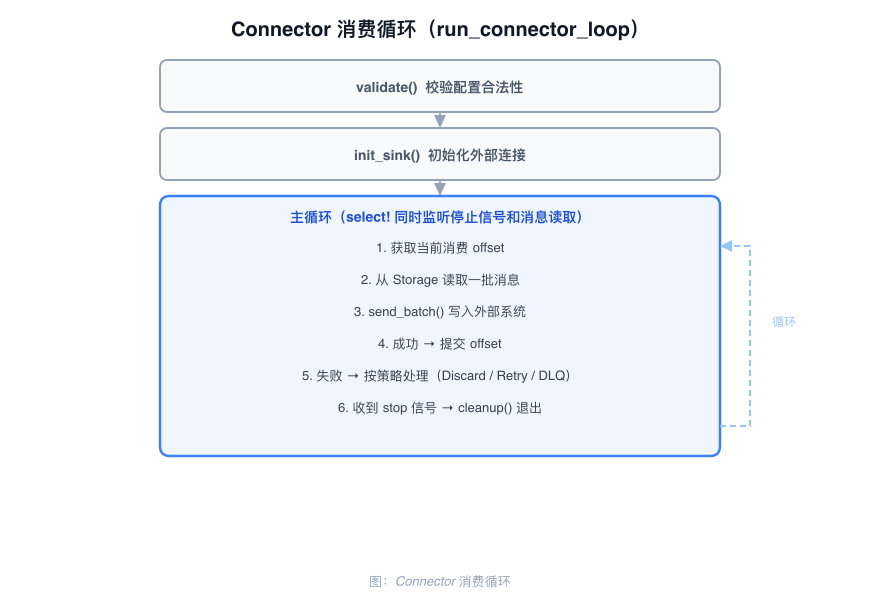
Execution flow for each Connector thread:
- Check the stop signal; exit the loop if received
- Call
read_by_offseton the Storage Adapter to fetch a batch of messages - If no messages are available, sleep briefly and retry
- Call
ConnectorSink::send_batchto write the messages to the external system - On success: commit the Offset and update the heartbeat timestamp
- On failure: apply the
failure_actionpolicy — discard, retry, or route to the dead-letter queue
ConnectorSink Trait
All external system Connectors implement this interface:
| Method | Description |
|---|---|
validate() | Validate connection configuration |
init_sink() | Initialize external connection resources |
send_batch() | Send a batch of messages to the external system |
cleanup_sink() | Release connection resources |
To add a new Connector type: implement ConnectorSink, add the type to the ConnectorType enum, and add dispatch logic in start_thread.
Failure Handling Policy
When send_batch fails, the configured policy determines behavior:
| Policy | Behavior |
|---|---|
Discard | Drop the batch and continue consuming the next one |
DiscardAfterRetry | Retry a configured number of times, then discard |
DeadMessageQueue | Retry a configured number of times, then send to dead-letter queue |
Heartbeat Mechanism
Broker side: Updates the local heartbeat timestamp on each successful message read. A heartbeat reporting thread periodically batches and sends these updates to Meta Service.
Meta side: ConnectorScheduler periodically checks heartbeats. Connectors that have timed out are reset to Idle and await rescheduling to a healthy Broker.
Offset Management
Each Connector maintains its own consume progress using connector_name as the consumer group name:
- Tracks the maximum offset per Shard on each read
- Commits offset after
send_batchsucceeds (at-least-once semantics) - Does not commit offset on failure
- After a Connector migrates to another Broker, consumption resumes from the last committed offset
Supported External Systems
| Type | Description |
|---|---|
| Kafka | Write to a Kafka Topic |
| Elasticsearch | Write to an ES Index |
| Redis | Execute Redis command templates |
| MongoDB | Write to a MongoDB Collection |
| MySQL | Write to a MySQL table |
| PostgreSQL | Write to a PostgreSQL table |
| RabbitMQ | Publish to a RabbitMQ Exchange |
| Pulsar | Publish to a Pulsar Topic |
| GreptimeDB | Write to GreptimeDB |
| LocalFile | Write to a local file |
Code Structure
src/connector/src/
├── traits.rs       ConnectorSink trait
├── loops.rs        Consume loop, offset management
├── core.rs         Broker-side scheduling, type dispatch
├── manager.rs      Runtime state management
├── heartbeat.rs    Heartbeat reporting thread
├── failure.rs      Failure handling policy
├── storage/        Meta Service storage interaction
├── kafka/
├── elasticsearch/
├── redis/
├── mongodb/
├── mysql/
├── postgres/
├── rabbitmq/
├── pulsar/
├── greptimedb/
└── file/