
DeleteRecords
DeleteRecords advances a partition's low watermark: it marks records before a given offset as unreadable and lets their space be reclaimed. It deletes a log prefix, not consumer offsets (deleting committed group offsets is a separate path — don't conflate the two).
Internally in RobustMQ the "low watermark" is the shard's
earliest_offset; the read layer exposes it asstart_offset, and the Kafka protocol calls itlow_watermark— all the same value.
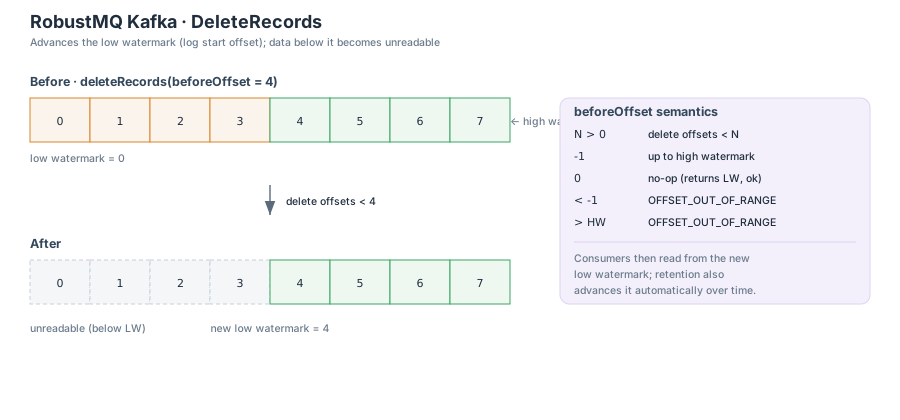
beforeOffset semantics
Each partition carries a beforeOffset:
beforeOffset | Behavior | Returns |
|---|---|---|
N > 0 | delete records with offset < N | new low watermark = achieved value |
-1 | delete up to the high watermark (all currently readable data) | new low watermark |
0 | no-op: nothing deleted, returns the current low watermark | success (error_code 0) |
< -1 (other negatives) | invalid | OFFSET_OUT_OF_RANGE |
> high watermark | out of range | OFFSET_OUT_OF_RANGE |
| unknown topic/partition | — | UNKNOWN_TOPIC_OR_PARTITION |
Note the difference between
0and< -1:beforeOffset = 0is a successful no-op; other negatives such as-2returnOFFSET_OUT_OF_RANGE, not a no-op.
How it runs
- The broker resolves each partition's target offset:
-1resolves to that partition's high watermark;> HWis flagged out of range. - The target goes to the storage layer, where it is first clamped to latest; if
target <= earliest(already deleted or lower), it returns the current low watermark without deleting. - Otherwise it deletes records in
[earliest, target)and movesearliest_offsetforward totarget— advancing the low watermark.
Physical-reclaim granularity
The low watermark advances exactly to target, but on-disk space is reclaimed at segment granularity:
- the File Segment engine only deletes sealed segments that fall entirely below
target; - it never deletes the active segment;
- if
targetlands inside a segment that must be kept, that segment is retained whole — records>= targetstay on disk, and those below the new low watermark simply become unreadable.
So the logical readable range shrinks immediately, while disk is freed only once an entire sealed segment sits below the low watermark.
Consumer behavior after deletion
After deletion, consumers read from the new low watermark. If a consumer requests an offset now below the new low watermark, it gets OFFSET_OUT_OF_RANGE and must relocate per its auto.offset.reset policy (typically to the earliest readable offset).
Relationship with retention
DeleteRecords advances the low watermark manually and immediately; time/size-based retention does the same thing automatically in the background (removing expired or oversized old segments and moving the low watermark forward). Both advance the same low watermark and compose: retention handles steady-state cleanup, while DeleteRecords is for on-demand truncation (e.g. compliance deletes, fast space reclaim).
CLI example
# Delete records with offset < 1000 in partition 0 of topic orders
kafka-delete-records.sh --bootstrap-server localhost:9092 \
--offset-json-file delete.jsondelete.json:
{
  "partitions": [
    { "topic": "orders", "partition": 0, "offset": 1000 }
  ],
  "version": 1
}
Segment structure and the low-watermark mechanism are covered in Storage Engine.