
Storage Engine
RobustMQ Kafka persists messages through the unified File Segment storage engine. The most fundamental difference from native Kafka: the storage layer keeps protocol-neutral, decoded records, not Kafka's private compressed byte batches. This lets the same data be read and written by multiple protocols — Kafka and MQTT — over one store.
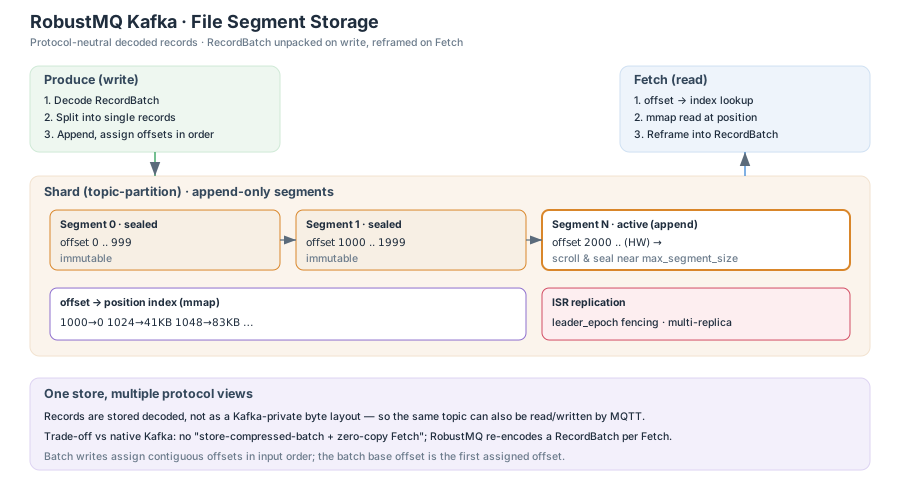
Segments
Each topic-partition (internally a shard) is split into a series of append-only segment files, at {data_fold}/{shard}/{segment_no}.msg:
- Append-only: the active segment is written sequentially with
append. - Scroll & seal: a new segment is created and the old one sealed when triggered. The trigger is a combination of two gates, not simply "full → scroll":
- the written offset reaches a scroll interval (checked every 10,000 offsets), and
- the current segment size exceeds ~90% of
max_segment_size. When both hold, the engine requests the next segment from meta-service (with retry); the new segment starts atprevious_end + 1and the old one is sealed as immutable.
- Segment size cap: per-shard
max_segment_size(default 1 GiB); the cluster-level default comes from the storage config keymax_segment_size.
Each record's on-disk layout (big-endian) is a fixed 24-byte header plus three variable sections:
offset(u64) | total_len(u32) | metadata_len(u32) | metadata
            | protocol_data_len(u32) | protocol_data | data_len(u32) | data
offset → position index and mmap reads
Reads locate data in two levels:
- Segment-range index: first map the offset to a specific segment (
SegmentOffsetIndex, offset-range → segment number). - In-segment position index: each segment maintains a persisted
offset → byte positionindex (in RocksDB). A read does a floor seek (the nearest entry not greater than the target offset) to get a start position.
With the start position, the engine mmaps the whole segment file (memmap2) and scans forward from there, skipping records with offset < start_offset, until it hits max_size (data bytes) or max_record. After a write flush the mmap cache is invalidated so the next read re-maps to the latest data.
Batch writes and offset assignment
On a batch write the engine reads the shard's current latest offset as the starting point and assigns contiguous offsets in input-list order (offset, offset+1, …), then saves max_offset + 1 as the new latest. Therefore:
- offsets within a batch are strictly contiguous and match input order;
- the Produce response base offset is the first offset assigned to the batch.
A past bug built the response from a
HashMap, scrambling the base offset; it is now fixed by sorting on offset, with a regression test locking the order.
ISR replication and leader_epoch fencing
- Multi-replica replication: writes go to the segment leader first; a non-leader forwards the write to the leader. With
acks=all(-1), if the ISR size is belowmin_in_sync_replicasthe write returnsNotEnoughReplicas, and it waits for the high watermark to advance past this write. - leader_epoch fencing: each leadership change bumps an epoch, recording
(epoch, start_offset)in a persistedLeaderEpochCache.OffsetsForLeaderEpochuses it: a request epoch below the current one →Fenced, above →Unknown, equal → returns that epoch's end offset as the follower's truncation point, preventing log divergence on split-brain.
Protocol-neutral storage: unpack on write, reframe on read
This is the crux of the difference from native Kafka:
- Produce (write): the
RecordBatchis fully decoded and flattened into individual records before storage (producer identity is taken from the batch's first record for idempotence checks). - Fetch (read): records read from storage are re-encoded into a v2, uncompressed
RecordBatchreturned to the client.
Differences from native Kafka, and why
| Aspect | Native Kafka | RobustMQ |
|---|---|---|
| Storage unit | stores the compressed RecordBatch as-is | protocol-neutral decoded records |
| Fetch path | zero-copy, ships the raw batch | reads records, reframes into a v2 uncompressed RecordBatch |
| Compression | preserves client compression | does not retain the original compressed batch |
| Multi-protocol | Kafka only | Kafka / MQTT share one store |
Why this design? RobustMQ's goal is "one data, multiple protocol views." If it stored Kafka's private compressed batches as-is, protocols like MQTT could not read the same data. Reframing per Fetch is a deliberate trade — it buys multi-protocol interop at the cost of Kafka's zero-copy and compression pass-through.
Related: low-watermark advancement and record deletion in DeleteRecords; overall layering in System Architecture.