Core Concepts
This document explains the core concepts of RobustMQ Kafka and how they map onto the unified RobustMQ kernel. If you know native Kafka, these concepts are identical; differences are called out explicitly.
Topic and Partition
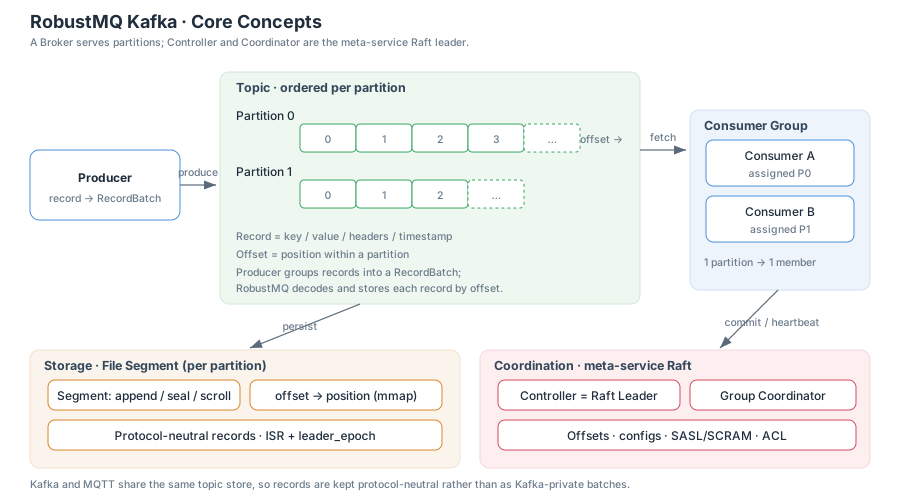
A Topic is a logical category of messages; a Partition is the topic's unit of parallelism and ordering.
- A topic consists of one or more partitions; ordering is guaranteed only within a single partition, not globally across partitions.
- The partition is the basic unit of parallelism: more partitions allow more concurrent producing / consuming.
- In RobustMQ, each partition maps to a storage-layer shard (a sequence of segments) persisted by the File Segment engine.
Offset
An Offset is the position of a record within a partition, increasing monotonically from 0.
- Offsets are assigned by the broker on write — contiguous and immutable.
- Consumption progress is the "committed offset", saved by the consumer group via
OffsetCommitand read viaOffsetFetch. ListOffsetsqueries the earliest / latest offset or locates by timestamp.
In RobustMQ, offsets are assigned by the storage layer on write, guaranteeing contiguous increments within a partition.
Record and RecordBatch
A Record is the smallest message unit, containing key, value, headers, and timestamp. A RecordBatch is a batch of records the producer packs and compresses together to improve throughput.
RobustMQ has a fundamental difference from native Kafka here:
| Native Kafka | RobustMQ | |
|---|---|---|
| Storage form | Stores the compressed RecordBatch as-is | Stores protocol-neutral, decoded records |
| Fetch | zero-copy, returns the original batch | Reads records and reframes them into a RecordBatch |
| Compression | Preserves the producer's compression encoding | Consumer side always returns uncompressed records |
The reason: Kafka and MQTT share the same topic data, so the storage layer must use a neutral format not bound to any single protocol. The cost is giving up Kafka's zero-copy and compression pass-through (see Compatibility & Limitations).
Producer
A Producer writes records to a topic's partitions.
- The target partition is chosen by hashing the key or by an explicit partitioner.
- Idempotent Producer: RobustMQ supports idempotent production.
InitProducerIdallocates a Producer ID, and the broker deduplicates using "sequence numbers + epoch fencing" — each(producer, partition)keeps a last-5 sliding window, and duplicate batches are safely discarded. - Transactional Producer: not supported.
InitProducerIdwith atransactional_idreturnsTRANSACTIONAL_ID_AUTHORIZATION_FAILED.
Consumer and Consumer Group
A Consumer pulls records from partitions; a Consumer Group is a set of consumers cooperatively consuming the same set of topics.
- Within a group, each partition is assigned to exactly one member, providing load balancing and horizontal scaling.
- Members joining / leaving triggers a rebalance, reassigning partitions.
- Progress is committed at "group + topic + partition → offset" granularity.
RobustMQ supports both generations of the consumer group protocol:
| Protocol | Related APIs | Assignment by |
|---|---|---|
| Classic | FindCoordinator / JoinGroup / SyncGroup / Heartbeat / LeaveGroup | Client (group leader) |
| KIP-848 | ConsumerGroupHeartbeat / ConsumerGroupDescribe | Server (coordinator) |
KIP-848 does not yet support
subscribed_topic_regex(regex subscription).
Broker, Controller, and Coordinator
A Broker is the node serving the Kafka protocol: it handles ApiVersions / Metadata and serves reads/writes for the partitions it owns.
The Controller and Coordinator are not separate components in RobustMQ — they are the meta-service Raft leader:
- Controller: the controller id returned by
Metadata/DescribeClusterpoints to the current Raft leader. - Group Coordinator: consumer group membership and offset commits are handled by the coordinator, which is also the Raft leader.
FindCoordinatorreturns its address. - Only the node that is the current Raft leader takes on coordination duties; otherwise it returns
NOT_COORDINATORand the client redirects. - The coordinator address is obtained via a gRPC lookup cached with a ~3s TTL, avoiding a metadata-layer hit on every request.
Native Kafka uses KRaft / ZooKeeper for the controller role; RobustMQ uses Raft uniformly, eliminating the separate coordination component.
Segment
A Segment is the physical storage unit of the File Segment engine — how a partition lands on disk:
- append / seal / scroll: records are appended to the current segment; once a threshold is reached the segment is sealed and rolled (scrolled) to a new one.
offset → positionindex + mmap reads: quickly locate the physical position by offset and read.- ISR multi-replica: segments are replicated across replicas, with
leader_epochfencing to block writes from a stale leader.
Concept mapping at a glance
| Kafka concept | Mapping in RobustMQ |
|---|---|
| Topic / Partition | Topic and shard in the unified kernel |
| Offset | Contiguous sequence assigned by the storage layer on write |
| RecordBatch | Decoded into the store on write, reframed on Fetch |
| Controller | meta-service Raft leader |
| Group Coordinator | meta-service Raft leader |
| Log Segment | Segment of the File Segment engine |