System Architecture
RobustMQ's Kafka capability is not a standalone Kafka service, but a Kafka protocol compatibility layer built on top of the unified RobustMQ kernel. It reuses RobustMQ's networking framework, the File Segment storage engine, and the Raft-based metadata service, and presents itself to the outside world as a standard Kafka broker — native Kafka clients and the official command-line tools connect to it directly.
Its most important design choice is "one data, multiple protocol views": Kafka and MQTT share the same topic store and metadata. The storage layer therefore holds protocol-neutral, decoded message records rather than any single protocol's private byte format. This choice drives many implementation decisions later on (for example, why it does not adopt Kafka's "store the compressed batch verbatim" model).
Layered Architecture
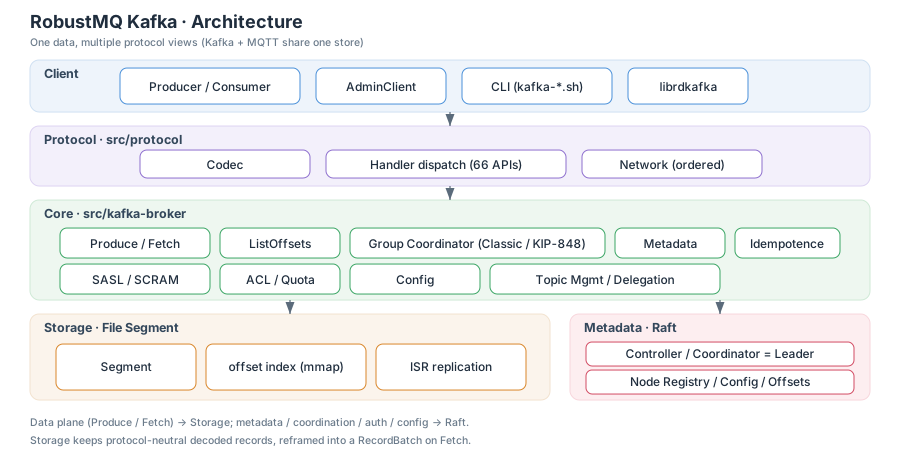
Top to bottom, there are five layers:
1. Client Layer
Any standard Kafka client can connect: Java kafka-clients (Producer / Consumer / AdminClient), the official CLI tools (kafka-topics.sh, kafka-console-producer.sh, kafka-consumer-groups.sh, etc.), and librdkafka-based clients. A client negotiates the available APIs and versions with the broker via ApiVersions, then sends and receives requests accordingly.
2. Protocol Layer (src/protocol)
Kafka wire-protocol encoding/decoding, based on kafka-protocol 0.17. Key points:
- Response header version is derived per API: the version at which each API becomes flexible (with tagged fields) differs, so it cannot be hard-coded. The protocol layer computes the header version from each response type's own
header_version(api_version); otherwise a non-flexible response (such as Produce v7) would get one extra byte and the client would misparse it. - Handler dispatch (
command.rs): routes each request to its handler by API key, currently covering 66 Kafka APIs. - Network layer: requests are sharded by connection so responses on a single connection stay strictly ordered (Kafka clients pair responses by correlation_id, but ordering avoids a class of races).
3. Core Layer (src/kafka-broker)
Where the Kafka semantics live:
- Data plane:
Produce(with idempotence),Fetch(long-poll),ListOffsets. - Consumer groups: the classic protocol (
FindCoordinator/JoinGroup/SyncGroup/Heartbeat/LeaveGroup) and the next-generation KIP-848 protocol (ConsumerGroupHeartbeat, server-side assignment) coexist. - Metadata & management:
Metadata,DescribeCluster, topic create/delete/expand, config read/write. - Security: SASL/SCRAM authentication, ACLs, client quotas, delegation tokens.
4. Storage Layer (File Segment engine)
Accessed through StorageDriverManager:
- Segment: append-only, sealed and scrolled to a new segment when thresholds are reached.
- offset→position index + mmap reads: locate the physical position by offset.
- ISR replication: multi-replica replication, with
leader_epochfencing.
Storage holds decoded records: Kafka Produce explodes the batch on write, and Fetch reframes a RecordBatch on read. The same topic is therefore also readable/writable by other protocols such as MQTT — the foundation of cross-protocol interoperability.
5. Metadata Layer (meta-service · Raft)
Cluster metadata is managed by the Raft-based meta-service:
- Controller / Coordinator is the Raft Leader: Kafka's controller id, the consumer-group coordinator, and the transaction coordinator all resolve to the current Raft leader (via a gRPC lookup cached with a ~3s TTL).
- Node registry: each node registers its externally-reachable addresses (see Advertised Listeners) for
Metadata/FindCoordinatorto hand back to clients. - Dynamic config & offsets: cluster dynamic config (e.g.
auto.create.topics.enable), consumer-group offsets, and ACL/SCRAM/quota data are all persisted here and hot-updatable.
Request Flow
- Data plane (Produce / Fetch): protocol layer decodes → core layer processes (idempotence check, size check) → storage layer writes/reads → response assembled. The storage layer assigns contiguous offsets on write.
- Metadata / coordination / auth / config: protocol layer decodes → core layer processes → reads/writes the Raft metadata layer. Only the current Raft leader (coordinator) takes on coordination duties; otherwise it returns
NOT_COORDINATORso the client redirects.
Key Differences from Native Kafka
| Aspect | Native Kafka | RobustMQ |
|---|---|---|
| Storage unit | stores the compressed RecordBatch verbatim (zero-copy Fetch) | protocol-neutral decoded records, reframed on Fetch |
| Controller | KRaft / ZooKeeper | meta-service Raft leader |
| Multi-protocol | Kafka only | Kafka / MQTT share the same data |
| Transactions | supported | not yet supported (see Compatibility & Limitations) |
For per-API support status, see the Protocol Compatibility Matrix.